Python code to visualize the radial velocity orbits published in Gaia DR3.
Note: Currently only supports queries for SB1 orbits. SB2 orbits will be added shortly!
Details on the NSS orbits: Gaia DR3 NSS_TWO_BODY_ORBIT Documentation
- Clone the repo
git clone https://github.com/tjayasinghe/gdr3binaryorbits.git
- Install with python
python setup.py install
Here is an example on how to use this project to retrieve and visualize an SB1 RV orbit published in Gaia DR3.
-
Create a NSS object
from gdr3binaryorbits.orbits import NSS

star=NSS()
-
A star can be loaded either through a cone search with RAJ2000 and DEJ2000 coordinates or through a direct query based on the Gaia DR3 source_id.
star.query_source('5853193426917488128') #Query by source_id
star.query_coords(219.41107637177004,-63.36791102568197) #Cone search
-
Once the star is loaded, query the Gaia DR3 NSS database and search for a SB1 orbit.
star.query_nss('SB1')We can visualize the orbit
star.plot_gaia_sb1()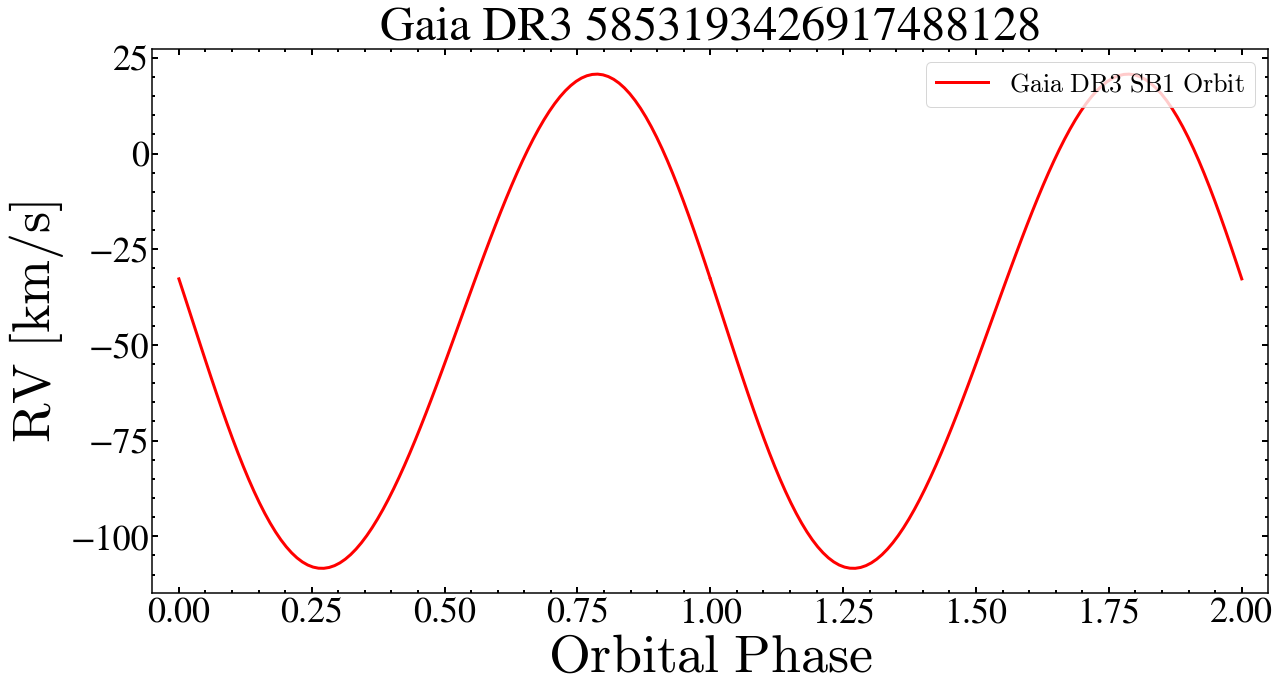
-
We can better understand the quality of the published orbit by looking at the published uncertainties. Draw from the published Gaia DR3 posteriors for the RV orbital parameters
star.draw_from_sb1_model(draws=500)
Visualize the published orbit along with the 500 orbits drawn from the posteriors.
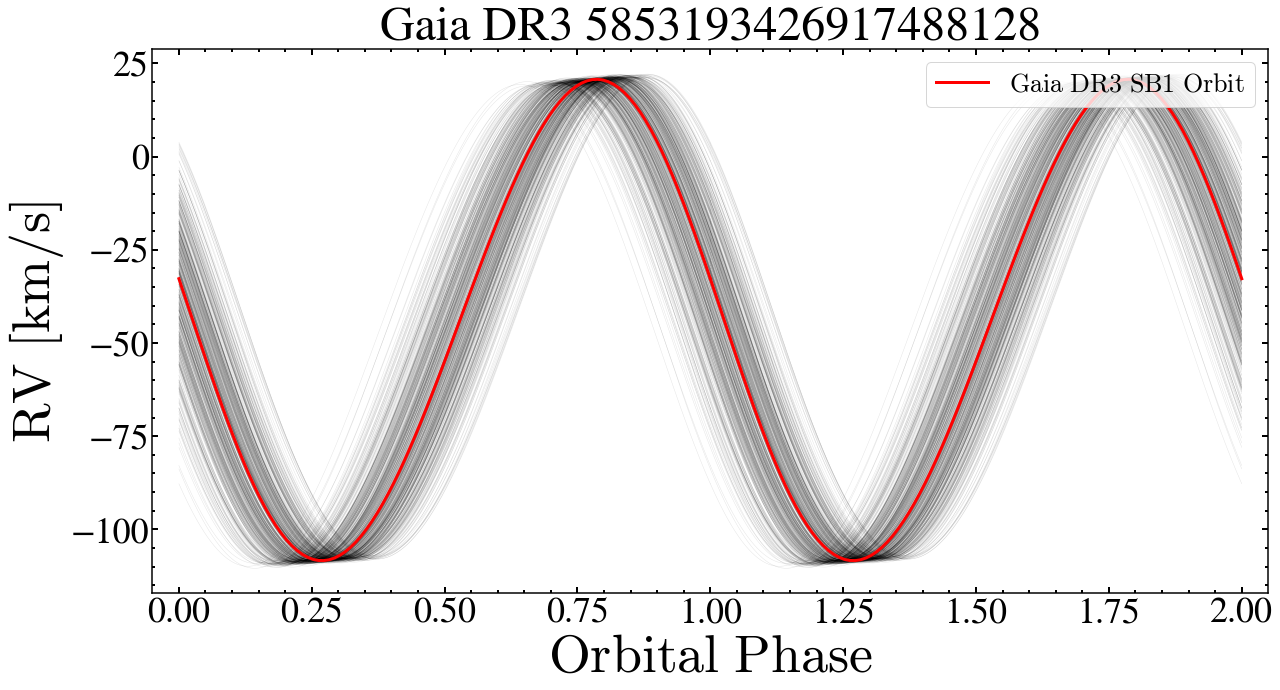
-
We can also look at the distribution of asini and f(M) for SB1 orbits.
star.get_sb1_fm_dist()
star.get_asini_dist()

print(f'f(M)={star.fm_50} +/- {star.fm_err} Msun')
print(f'asini_1={star.asini1_50} +/- {star.asini1_err} Rsun')
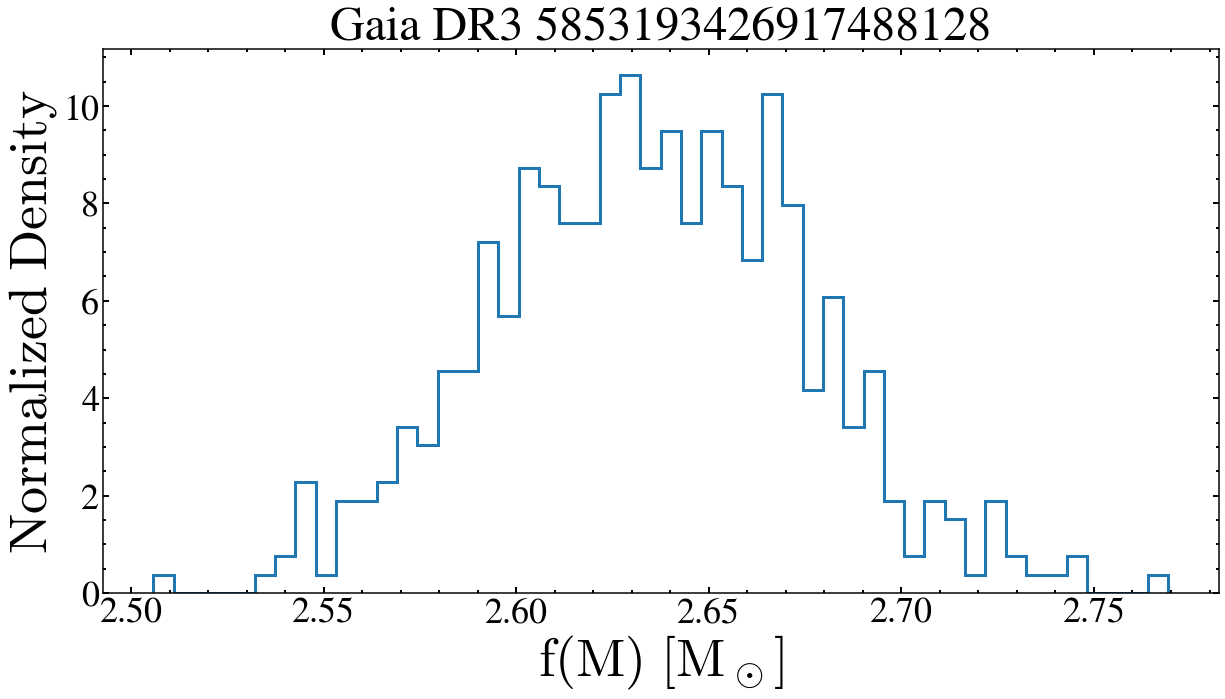
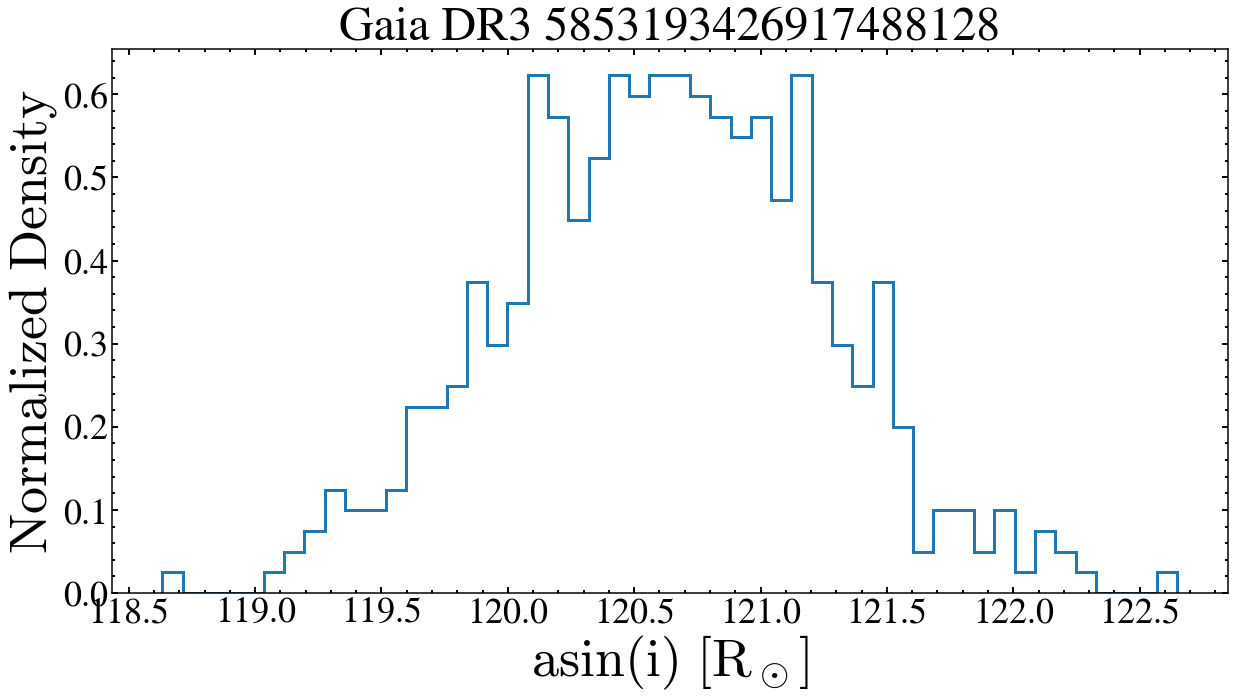
-
If you are interested in targeting follow-up of the next RV min/max, this can also be handled:
star.predict_next_rvminmax()
print(f'Next RV maximum of {round(star.rv_max,1)} km/s will occur on JD={round(star.jd_next_rv_max,5)}.')
print(f'Next RV minimum of {round(star.rv_min,1)} km/s will occur on JD={round(star.jd_next_rv_min,5)}.')
Distributed under the MIT License. See LICENSE.txt for more information.