- Parses CIM RDF/XML data to pandas dataframe with 4 columns [ID, KEY, VALUE, INSTANCE_ID] (triplestore like)
- The solution does not care about CIM version nor namespaces
- Input files can be xml or zip files (containing one or mutiple xml files)
- All files are parsed into one and same Pandas DataFrame, thus if you want single file or single data model, you need to filter on INSTANCE_ID column
https://haigutus.github.io/triplets
Upgrading from 0.0.x? See docs/migration_0.0_to_0.1.md.
# Core (python_lxml_pandas engine, no extra deps)
pip install triplets

# With pyarrow (enables python_lxml_arrow + cython_pugixml_arrow engines, ~12x faster)
pip install triplets[arrow]
Install extras by feature:
| Extra | Enables |
|---|---|
arrow |
compiled Arrow parser engines (~12x faster parsing) |
polars |
polars DataFrames (polars.read_rdf, .triplets namespace) |
duckdb |
DuckDB connections (con.read_rdf, SQL over triplets) |
sparql |
SPARQL queries (rdflib reference engine) |
oxigraph |
recommended pip performance path — embedded Rust SPARQL engine (auto-preferred over rdflib) |
validation |
SHACL validation (pyshacl reference engine) |
excel / networkx / visualization |
Excel export / graph export / drawing |
The embedded qlever SPARQL engine (fastest) ships in no wheel — it is a local source build, see docs/building.md.
import pandas
import triplets

path = "CGMES_v2.4.15_RealGridTestConfiguration_v2.zip"
data = pandas.read_RDF([path])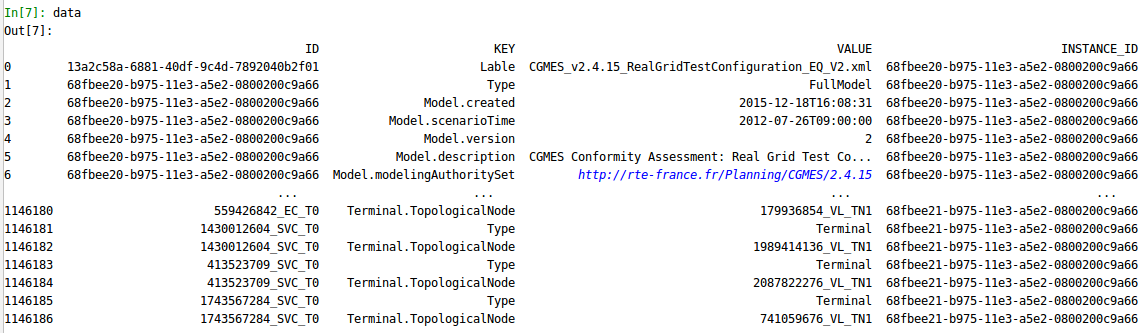
You can then query a dataframe of all same type elements and its parameters across all [EQ, SSH, TP, SV etc.] instance files, where parameters are columns and index is object ID-s
data.tableview_by_type("ACLineSegment")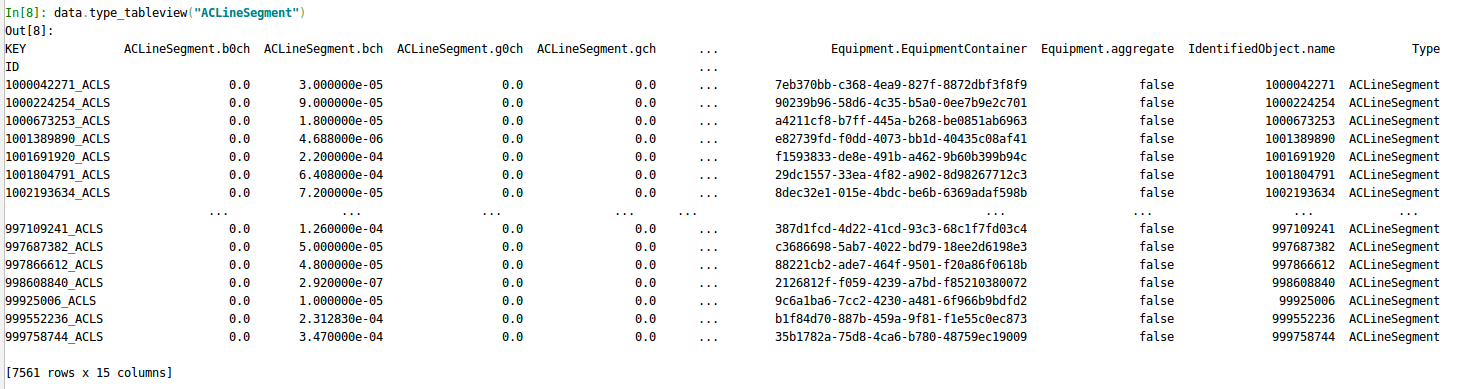
data.export_to_cimxml(
    rdf_map=schemas.ENTSOE_CGMES_2_4_15_552_ED1,
    export_type=ExportType.XML_PER_INSTANCE_ZIP_PER_XML,
)
Look into examples folders for more
Three parser engines with automatic fallback (fastest available):
| Engine | Install | Speed |
|---|---|---|
python_lxml_pandas |
pip install triplets |
1x baseline, always works |
python_lxml_arrow |
pip install triplets[arrow] |
~1x, better interop |
cython_pugixml_arrow |
pip install triplets[arrow] (included in wheels) |
12x faster |
The cython_pugixml_arrow engine is a compiled C++ extension included in published wheels.
It requires pyarrow at runtime, so install with triplets[arrow] to enable it.
The cython engine is pre-built in published wheels — no compilation needed.
import polars
import triplets

data = polars.read_rdf(["grid_EQ.xml", "data.zip"])   # returns polars DataFrame

data.triplets.get_types_count()
data.triplets.tableview_by_type("ACLineSegment")
data.triplets.filter_triplets(KEY="Type", VALUE=".*Generator.*", regex=True)
data.triplets.export_to_csv(export_to_memory=True)
data.triplets.export_to_nquads("/tmp/output.nq")import duckdb
import triplets
data = duckdb.connect() # in-memory
data = duckdb.connect("grid.duckdb") # persistent (no re-parsing next session)
data.read_rdf(["grid_EQ.xml", "data.zip"]) # parse via Arrow (zero-copy into DuckDB)
data.get_types_count() # → dict
data.tableview_by_type("ACLineSegment").df() # → pandas DataFrame
data.tableview_by_type("ACLineSegment").pl() # → polars DataFrame
data.filter_triplets(KEY="Type", VALUE=".*Sub.*", regex=True).df()
data.filter_triplets_by_type("Terminal").df()
data.references_to("some-uuid").df()
data.export_to_nquads("/tmp/output.nq")
# Direct SQL (full DuckDB SQL on the triplets table)
data.sql("SELECT VALUE, COUNT(*) FROM triplets WHERE KEY = 'Type' GROUP BY VALUE").df()
# The same tools are also on the `.triplets` namespace (parity with pandas/polars)
data.triplets.tableview_by_type("ACLineSegment").df()
data.triplets.get_types_count()SPARQL 1.1 over the loaded data — SELECT → DataFrame, ASK → bool,
CONSTRUCT → triplet DataFrame. Works on pandas, polars and DuckDB inputs:
PREFIXES = """
PREFIX rdf: <http://www.w3.org/1999/02/22-rdf-syntax-ns#>
PREFIX cim: <http://iec.ch/TC57/CIM100#>
"""
names = data.sparql.query(PREFIXES + "SELECT ?s ?name WHERE { ?s cim:IdentifiedObject.name ?name }")
Three engines behind one API (auto picks the fastest available):
| Engine | Install | Role |
|---|---|---|
qlever |
local source build (docs/building.md) | fastest — embedded C++, persistent on-disk index |
oxigraph |
pip install triplets[oxigraph] |
embedded Rust — ~3x faster import, 2–5x faster queries than rdflib |
rdflib |
pip install triplets[sparql] |
pure-Python reference |
Details and measured numbers: docs/sparql.md.
Validate against SHACL shape files; the result is a violations DataFrame (empty = conforms) with the same shape across all engines:
violations = data.shacl.validate("shapes.ttl", rdf_map=schemas.ENTSOE_CGMES_3_0_0_552_ED1)

# slower optional context pass: source file, object type/name,
# shape sh:name/sh:description, schema attribute/class definitions
violations = data.shacl.validate(shapes, context=True)

# SARIF 2.1.0 for GitHub / SonarQube / any SARIF viewer — grouped by default
# (one result per rule with occurrenceCount + sample instances)
violations.shacl.to_sarif(path="report.sarif")
Engines: polars (auto, real profiles in ~2 s) → pandas → pyshacl
(reference); duckdb for larger-than-memory data. sh:sparql constraints
ride the SPARQL engine above (minutes → milliseconds with oxigraph/qlever).
Details: docs/validation.md.
pandas and polars DataFrames use df.triplets.*; a DuckDB connection uses
con.triplets.*. The same method names are available on both (DuckDB returns
relations — add .df() or .pl() when needed):
# pandas / polars
df.triplets.tableview_by_type("ACLineSegment")
df.triplets.export_to_nquads("/tmp/output.nq")

# DuckDB
con.triplets.tableview_by_type("ACLineSegment").df()
con.triplets.get_types_count()
Root-level methods (df.type_tableview(...), con.filter_triplets(...)) still
work for backwards compatibility.
cim-spreadsheet -i model.xml -o output.xlsx
cim-diff original.xml modified.xml| Operation | pandas | polars | DuckDB |
|---|---|---|---|
| Parse (cython engine) | 128ms | 156ms | 283ms |
| tableview_by_type | 72ms | 21ms | 53ms |
| filter_triplets_by_type | 103ms | 9ms | 50ms |
| get_types_count | 21ms | 11ms | 18ms |
The old rdf_parser.py functions still work but emit deprecation warnings.
See docs/migration_0.0_to_0.1.md for renames and breaking changes.